Choosing the right roll forming equipment can shape a factory’s productivity, product quality, and long-term operating costs. For global buyers, the decision involves more than comparing machine prices. Material thickness, profile design, production volume, factory space, labor skills, and local service support all deserve careful attention. This guide examines seven major Types Of Roll Forming Machines used across construction, transportation, energy, and general manufacturing.
Each machine type serves a different production purpose. A roofing panel machine may produce continuous sheets with clean ribs and accurate overlaps. A purlin machine must handle stronger steel and maintain reliable punching precision. Other options include floor decking, cable tray, stud and track, downpipe, and customized machines. These examples show how tooling design directly affects forming speed, dimensional stability, and waste control. Small errors can become expensive at high volume.
Practical experience also matters. A machine that performs well in one factory may not suit another. Operators should inspect frame strength, roller quality, drive systems, electrical standards, safety guarding, and spare-part availability. Supplier references and test-production videos can reveal details that brochures often miss. Still, specifications do not tell the whole story. Some buyers focus too heavily on maximum speed, while actual output depends on loading, cutting, changeover, and maintenance time. That assumption deserves review. By comparing these seven machine categories carefully, global buyers can make a more informed and dependable investment. Performance should be verified, not simply promised.
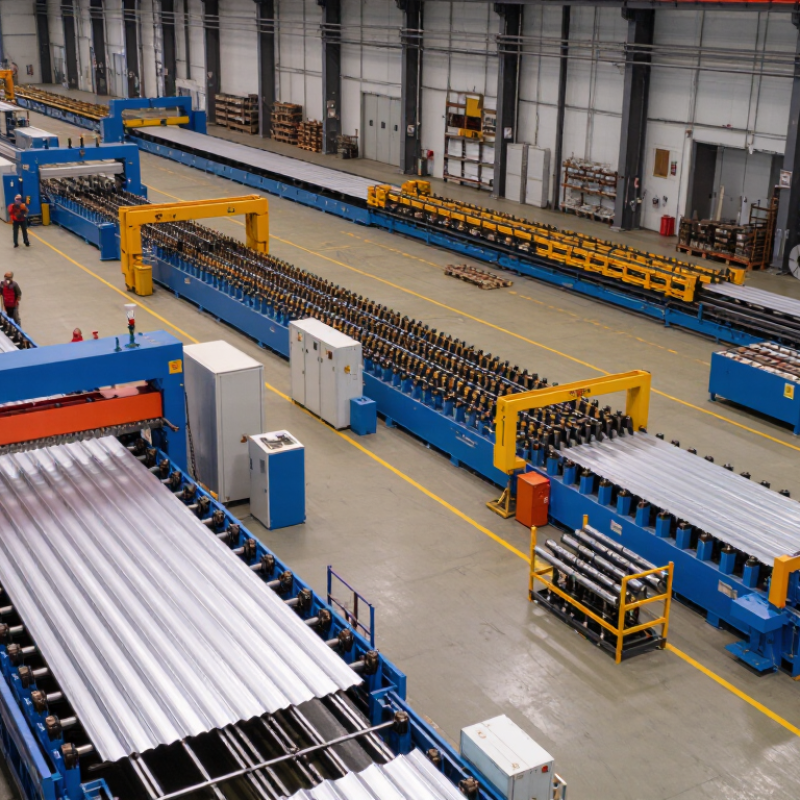
7 Best Types Of Roll Forming Machines For Global Buyers
What Is a Roll Forming Machine and How Does It Work?
A roll forming machine continuously shapes metal coils into precise profiles. The line usually includes a decoiler, leveling unit, roller stations, and a cutting system. The strip keeps moving. Each roller set bends the material slightly, preventing sharp stress points and uneven edges. A programmable control system then measures length and triggers the cut-off unit. This process suits roofing panels, wall studs, purlins, cable trays, door frames, and structural channels.
Machine selection depends on the finished profile, metal thickness, coil width, and required output. Roofing and floor-deck machines often use long roller trains. Purlin and framing machines require stronger forming stands. According to the World Steel Association’s 2024 World Steel in Figures, global crude steel production reached about 1.89 billion tonnes in 2023. That scale supports continued demand for efficient steel-processing equipment, but demand alone does not guarantee a good purchase.
On a production floor, alignment matters more than impressive speed figures. A small entry error can create cumulative profile deviation after twelve or more stations. In my view, this is where many specifications become too optimistic. The International Energy Agency reports that industry remains a major global energy user, so motor efficiency and idle-time control deserve attention. Buyers should test sample coils, inspect cut accuracy, and confirm changeover time. A machine that runs fast but wastes material is not truly efficient. Calibration still needs patience.
A roll forming machine is a continuous metal-processing system that gradually bends strip or coil stock through a series of profiled rollers to produce a uniform cross-section. Typical systems include an uncoiler, leveling or guiding unit, roll forming stands, cutting equipment, and an electrical control system.
| Machine Type | Typical Products | Common Materials | Typical Material Thickness | Typical Line Speed | Main Advantages | Typical Applications |
|---|---|---|---|---|---|---|
| Roof Panel Roll Forming Machine | Corrugated sheets, trapezoidal panels, standing-seam panels, and concealed-fastener roofing | Galvanized steel, pre-painted steel, aluminum, and coated steel | 0.30–0.80 mm for steel; up to about 1.20 mm for some aluminum profiles | 8–25 m/min, depending on profile and cutting method | Continuous production, consistent panel geometry, and low material waste | Residential, commercial, agricultural, and industrial roofing |
| Wall Panel Roll Forming Machine | Ribbed wall panels, insulated-panel skins, interior panels, and facade cladding | Pre-painted steel, galvanized steel, stainless steel, and aluminum | 0.35–0.80 mm for most architectural panels | 8–30 m/min | Suitable for long panels, repeatable profiles, and customized surface designs | Building envelopes, partitions, factories, warehouses, and cold-storage facilities |
| Purlin Roll Forming Machine | C-shaped, Z-shaped, and sigma-shaped structural purlins | Hot-dip galvanized steel and high-strength low-alloy steel | 1.50–3.00 mm, with heavy-duty systems handling thicker stock | 10–25 m/min | Adjustable sizes, automatic punching options, and efficient structural production | Steel buildings, roof structures, wall framing, and portal-frame construction |
| Stud and Track Roll Forming Machine | C-studs, U-tracks, furring channels, and framing sections | Galvanized steel and light-gauge cold-rolled steel | 0.45–1.50 mm | 20–60 m/min, depending on punching and cut-to-length requirements | High throughput, integrated hole punching, and accurate framing dimensions | Drywall systems, modular buildings, interior partitions, and light-gauge construction |
| Decking Roll Forming Machine | Floor decking, roof decking, composite deck profiles, and structural deck sheets | Galvanized structural steel and coated steel | 0.75–1.50 mm; heavier designs may require specialized equipment | 8–20 m/min | High load-carrying efficiency, repeatable rib geometry, and long-length production | Multi-story floors, concrete formwork, roofs, and steel-frame buildings |
| Guardrail Roll Forming Machine | W-beam guardrails, thrie-beam barriers, spacer blocks, and mounting sections | Hot-dip galvanized steel and high-strength structural steel | 2.50–4.00 mm, depending on barrier design and impact requirements | 6–15 m/min | Strong profiles, integrated punching, and consistent hole spacing for installation | Highways, bridges, parking areas, road medians, and traffic-safety infrastructure |
| Cable Tray Roll Forming Machine | Ladder cable trays, perforated trays, solid-bottom trays, and support channels | Galvanized steel, stainless steel, aluminum, and pre-coated steel | 0.80–2.50 mm | 8–25 m/min, with speed affected by perforation patterns | Flexible width options, precise perforations, and efficient repeat production | Data centers, factories, commercial buildings, power facilities, and industrial plants |
Note: The values shown are typical industry ranges rather than universal specifications. Actual speed, thickness capacity, roll-stand count, motor power, and profile size depend on the material grade, product geometry, punching requirements, cutting system, and applicable regional standards.
It continuously bends metal coils into consistent profiles. The strip keeps moving. Rollers shape it gradually, reducing stress and uneven edges.
A typical line includes a decoiler, leveling unit, roller stations, control system, and cutting unit. Each part affects final accuracy.
Common materials include galvanized steel, pre-painted steel, high-strength steel, and aluminum. Coating quality matters. Scratches can appear during forming.
They can produce roofing panels, wall panels, floor decks, purlins, studs, tracks, cable trays, door frames, and structural channels. Some lines also form tubes and solar rails.
Match the machine to the profile, material thickness, coil width, and required output. A roofing line may need long roller trains. A purlin line needs stronger forming stands.
A small entry error can increase after twelve or more roller stations. The final section may twist or deviate. Speed cannot repair poor alignment.
Test the buyer’s actual coil whenever possible. Check profile dimensions, cut length, punching accuracy, surface condition, and changeover time. Ask for measured results, not only promises.
No. Material waste, idle time, energy use, and adjustment time also matter. A fast line can still perform poorly. This point is easy to underestimate.
Repeated holes and precise bends require stable feeding. Recoiling, punching errors, or coating scratches may appear. Some projects still need manual adjustment.
Calibration usually requires patience and repeated checks. Roller alignment, cutting length, and material tension may need adjustment. The first sample is rarely perfect.
Roll forming machines are continuous metal-shaping systems that gradually bend coils or strips through a series of rollers to create precise, consistent profiles. This article introduces seven major Types Of Roll Forming Machines for global buyers, including systems for panels, roofing sheets, structural sections, tubes, rails, door frames, and customized profiles. Each machine type is suited to specific materials, thicknesses, production speeds, and end-use applications.
The guide also explains how to compare essential specifications such as forming width, roller stations, motor power, cutting method, dimensional accuracy, automation level, and floor-space requirements. To choose the right equipment, buyers should evaluate local market demand, material availability, required profile complexity, production volume, maintenance capabilities, energy use, and after-sales support. A well-matched machine can improve production consistency, reduce material waste, and provide flexible manufacturing performance for construction, transportation, infrastructure, and general fabrication projects.

 Xiongchang