What Is A Roll Forming Machine? 2026 Top Types Explained
What Is A Roll Forming Machine? It is a production system that bends continuous metal strip through carefully aligned roller stations. Each station performs a small change. Together, they create precise profiles without cutting the strip into separate pieces. Imagine a steel coil entering one side and leaving as a finished roof panel, track, channel, or structural frame.
According to roll-forming specialist Chuck Summerhill, “Consistency begins with proper tooling, setup, and material control.” This practical observation remains important in 2026. A fast machine cannot correct poor coil quality, incorrect roller spacing, or unstable feeding. Operators still inspect the first profile with calipers and compare it against the engineering drawing. Small errors can become serious across hundreds of meters.
This guide examines the leading roll forming machine types used in modern factories. It covers standard machines, duplex systems, cassette machines, servo-controlled lines, and custom production equipment. Each type suits different materials, profile shapes, volumes, and changeover requirements. Some lines prioritize speed. Others prioritize flexibility.
The choice is not always obvious. A compact machine may save floor space but limit profile complexity. A high-speed line may increase output but demand stricter maintenance. That trade-off deserves attention. We will also consider tooling design, automation, safety controls, material thickness, and operating costs. These details often decide whether a machine performs reliably beyond the showroom.
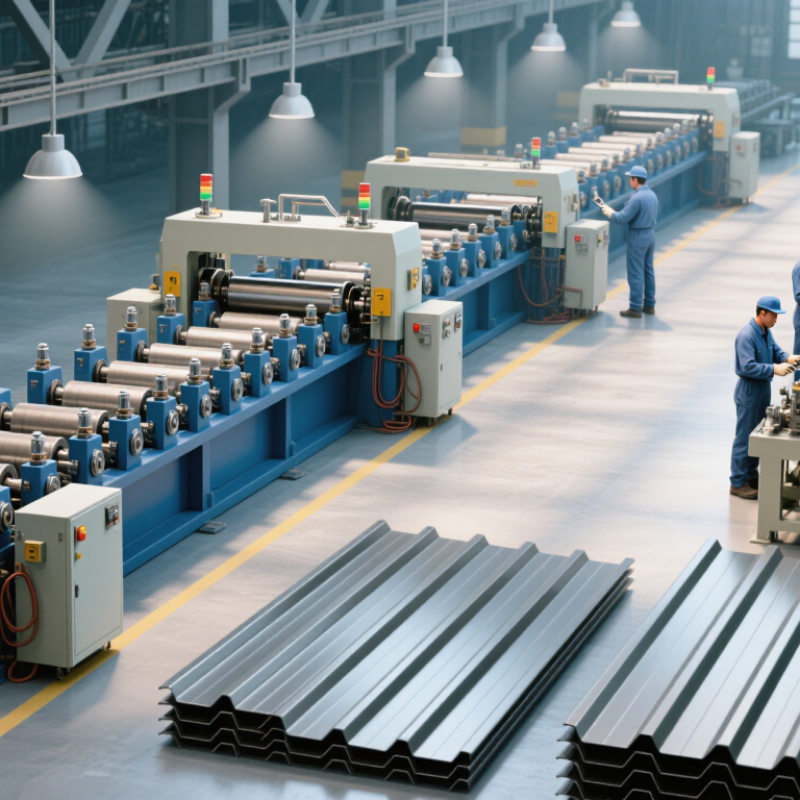
A roll forming machine shapes continuous metal strip into precise profiles. It uses paired rollers arranged along a production line. Each roller station bends the strip gradually, rather than forcing one sharp fold. This controlled process reduces surface damage and keeps the profile consistent. The line may include a decoiler, guide rollers, forming stands, a cutting unit, and an exit table. Operators set the material width, thickness, forming speed, and cutting length. Common types include C-channel, roof panel, standing seam, and tube roll forming machines. The best choice depends on the required profile and production volume.
During operation, the decoiler feeds the strip into the guides. Rollers then apply measured pressure from both sides. A computer-controlled system can coordinate speed and cutting movements. However, automation does not replace careful inspection. Small alignment errors may create twisting, uneven edges, or inaccurate holes. Experienced operators check the first pieces with calipers and profile gauges. They also watch for vibration, oil leaks, and unusual roller noise. I have found that production estimates can look impressive, yet setup time is often underestimated.
Tips: Confirm the metal grade before selecting tooling. Keep the strip centered throughout the line. Record roller adjustments for repeat orders. Inspect several finished pieces, not only the first one. Clean debris from guides and rollers regularly. A slower trial run is usually safer. Still, excessive speed can hide defects until many pieces are complete.
| Roll Forming Machine Type | Typical Products | How It Works | Common Material | Typical Thickness Range | Key Advantages | Common Limitations | Typical Applications |
|---|---|---|---|---|---|---|---|
| Standard Sheet Roll Former | Roof panels, wall panels, siding, cladding sheets | Continuous metal strip passes through multiple roll stations that gradually form the sheet profile without removing material. | Galvanized steel, pre-painted steel, stainless steel, aluminum | Approximately 0.30–1.20 mm, depending on the profile and machine design | High production speed, consistent profiles, low material waste | Best suited to long, continuous profiles; changing profiles may require roll tooling adjustments. | Building envelopes, roofing, commercial and industrial construction |
| Purlin Roll Forming Machine | C-shaped and Z-shaped structural purlins | Roll stations form structural sections, while punching units can create holes for bolted connections before or after forming. | Structural galvanized steel and carbon steel | Approximately 1.50–3.00 mm for many building applications | Suitable for structural members and automated hole punching | Requires accurate setup to control springback and maintain dimensional tolerances. | Steel buildings, warehouses, agricultural structures, industrial frames |
| Stud and Track Roll Former | Metal framing studs, tracks, channels | Thin-gauge steel strip is progressively shaped into open sections used for interior and exterior framing systems. | Galvanized steel and light-gauge cold-rolled steel | Approximately 0.40–1.20 mm | Fast continuous production and accurate repeatability | Profile performance depends on material strength, flange geometry, and hole-punching accuracy. | Drywall systems, partition walls, ceilings, modular construction |
| Cable Tray Roll Former | Ladder cable trays, perforated cable trays, solid-bottom trays | Flat strip is formed into tray sidewalls and bends; punching systems may produce ventilation or mounting holes in line. | Galvanized steel, stainless steel, aluminum | Approximately 0.80–2.00 mm | Combines forming and in-line perforation for efficient production | Hole patterns and tray widths are profile-specific and may require dedicated tooling. | Electrical distribution, data centers, factories, commercial buildings |
| Guardrail Roll Forming Machine | Highway W-beam and thrie-beam barriers | Heavy-gauge steel strip is progressively formed into roadside safety barrier profiles, often with in-line punching. | Hot-dip galvanized structural steel | Approximately 2.50–4.00 mm | Produces long, uniform safety barriers with repeatable hole positioning | Requires high forming force, robust tooling, and careful control of material strength. | Highways, bridges, parking areas, roadside infrastructure |
| Downspout and Gutter Roll Former | Rain gutters, downpipes, eave channels | Coiled sheet is shaped into curved or rectangular drainage profiles, followed by cutting to required lengths. | Pre-painted steel, aluminum, galvanized steel, copper | Approximately 0.40–0.80 mm | Compact production lines and flexible length control | Thin materials can be sensitive to scratching, edge deformation, and incorrect roll alignment. | Residential roofing, commercial buildings, rainwater management |
| Door and Window Frame Roll Former | Frames, jambs, tracks, reinforcement sections | Multiple roll stations form narrow, detailed profiles; punching, notching, and cutting can be integrated into the line. | Galvanized steel, stainless steel, aluminum | Approximately 0.60–2.00 mm | Accurate production of repeatable narrow profiles with integrated operations | Complex sections require precise tooling design and strict dimensional control. | Doors, windows, partitions, architectural systems |
| Automotive Structural Roll Former | Roof rails, impact beams, seat tracks, reinforcement members | High-strength strip is progressively formed, often with pre-punching, welding, or additional calibration processes. | High-strength steel, advanced high-strength steel, aluminum | Approximately 0.80–3.00 mm, depending on the component | Efficient production of lightweight, long structural components | High-strength materials can increase springback and require specialized forming analysis. | Vehicle bodies, chassis components, transport equipment |
| Tube and Pipe Roll Former | Round tubes, square tubes, rectangular tubes | Flat strip is gradually formed into a closed shape and longitudinally welded before sizing and cutting. | Carbon steel, galvanized steel, stainless steel, aluminum | Approximately 0.50–6.00 mm, depending on tube size and line configuration | Continuous production of welded tubular sections with sizing control | Usually requires welding equipment, sizing stands, and strict weld-quality monitoring. | Construction, furniture, mechanical equipment, automotive components |
| Track-Mounted or Portable Roll Former | Standing-seam roof panels and long-site-formed roofing sheets | The machine forms panels continuously from a coil and can travel along a prepared production path or operate near the installation site. | Pre-painted steel, galvanized steel, aluminum, copper | Approximately 0.50–0.90 mm | Reduces transport limitations for very long panels | Production conditions depend on site access, power supply, weather, and coil handling. | Large roofs, industrial buildings, agricultural buildings, long-span roofing |
| Servo-Controlled Roll Forming Line | Profiles requiring accurate variable lengths, holes, slots, or notches | Servo drives synchronize feeding, punching, forming, and flying cutting through programmable controls. | Steel, stainless steel, aluminum, and other coil-fed metals | Determined by the product profile and line configuration | Improved synchronization, flexible part lengths, and reduced manual handling | Higher equipment complexity requires skilled programming, maintenance, and setup. | Automated construction components, industrial profiles, custom production |
It gradually bends continuous metal strip through matched rotating rolls. Each station makes a small change. This reduces cracking and distortion.
Typical components include a decoiler, straightener, entry guides, roll stations, drive system, cutoff unit, and PLC. Stable bearings matter too.
The decoiler unwinds the coil under controlled tension. The straightener removes coil memory. Guides center the strip before forming starts.
Choose based on profile shape, material strength, thickness, tolerance, and production volume. Common options include standard, cassette, double-layer, framing, and precision systems.
Record strip width, thickness, yield strength, finished dimensions, line speed, and cutting accuracy. Include changeover time and operator access.
Request sample trials using your actual coil material. A thin coated section may need different tooling from structural steel. Brochures are not enough.
Edge waves often indicate poor alignment or incorrect guide settings. Springback may require revised forming passes or adjusted tooling.
Yes. A smooth surface can hide internal stress. Inspect samples and record dimensions, because appearance alone can mislead.
Check strip thickness, roll gaps, yield strength, line speed, and lubricant before changing tooling. Adjust gradually. One overlooked guide can spoil a coil.
Automation can improve control and repeatability. However, it may add unnecessary cost when product variety is low. Compare actual scrap and setup hours.
What Is A Roll Forming Machine? It is a specialized metalworking system that continuously bends long strips of sheet or coil material into precise, consistent profiles through a series of matched rollers. The process typically includes material feeding, leveling, progressive forming, cutting, and profile support. Key components may include the uncoiler, guide system, forming stands, drive mechanism, cutting unit, control system, and discharge table.
In 2026, common machine types include systems for roofing panels, wall panels, framing sections, cable trays, door tracks, highway barriers, and customized structural profiles. Roll forming is widely used with materials such as galvanized steel, stainless steel, aluminum, and pre-painted metal across construction, transportation, energy, storage, and manufacturing industries. Choosing the right machine requires evaluating the target profile, material thickness, production speed, dimensional accuracy, changeover needs, automation level, available workspace, maintenance requirements, and overall budget.

 Xiongchang